Checklist: Checking machinery supplier capabilities
A machinery supplier can show a polished catalog and still lack evidence for the buyer’s actual operating conditions, throughput, integration, maintenance, or safety needs. Capability review should connect the application to engineering data, manufacturing controls, test results, documentation, and service support. Buyers should define what must be demonstrated before comparing price or approving a machine.
Key takeaways
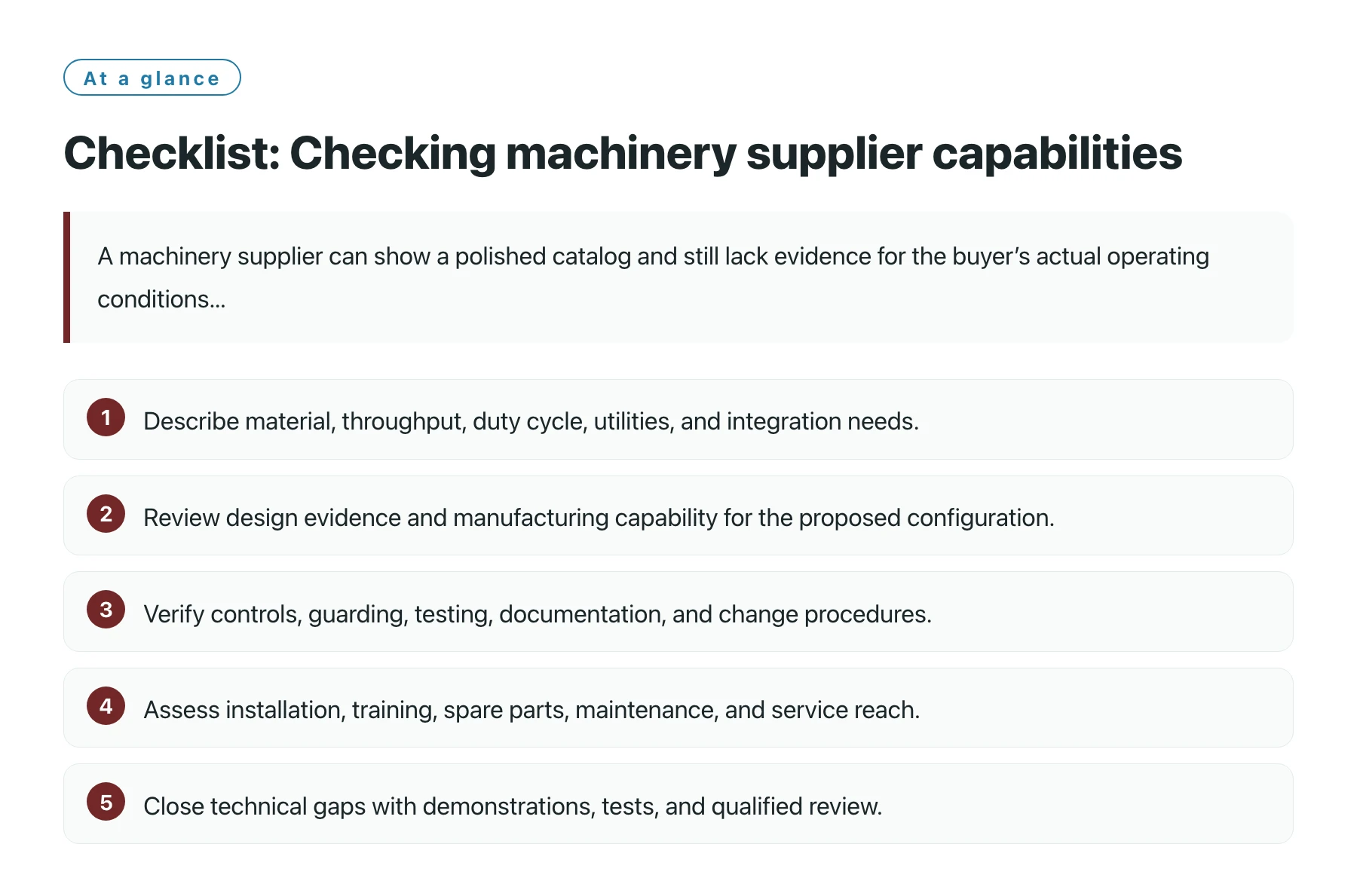
- Describe material, throughput, duty cycle, utilities, and integration needs.
- Review design evidence and manufacturing capability for the proposed configuration.
- Verify controls, guarding, testing, documentation, and change procedures.
- Assess installation, training, spare parts, maintenance, and service reach.
- Close technical gaps with demonstrations, tests, and qualified review.
Review the complete equipment package, including the machine, options, interfaces, documentation, and support needed to operate it.
1. Define the intended operation
Describe the product or material processed, input variation, target output, shift pattern, duty cycle, environmental conditions, available utilities, operator skill, and downstream interfaces. State required dimensions, accuracy, capacity, changeover time, and cleaning or maintenance expectations.
Identify operating constraints such as floor space, noise, temperature, dust, process hazards, or integration with existing lines. Have engineering and operations owners distinguish essential requirements from preferences so suppliers can respond to a common basis.
2. Confirm the exact machine configuration
Record model, options, tooling, software, control system, guarding, sensors, feeders, conveyors, spare parts, and accessories. Ask whether the offer covers a standard machine or a customized build. Identify all components supplied by third parties.
Require drawings and a bill of supply that match the quotation and demonstration unit. Product-family brochures may show options not included in the offer. Mark every proposed deviation and obtain buyer review before treating a configuration as compliant.
3. Evaluate engineering and application evidence
Request technical specifications, process diagrams, layout drawings, load limits, operating ranges, cycle assumptions, and evidence from similar applications. Ask for performance data tied to material, tooling, configuration, and test conditions. Review the limits and exclusions as well as headline throughput.
If performance depends on the buyer’s material or process, define a factory acceptance or application test with representative inputs, setup, sample duration, measurements, and pass criteria. A demonstration on a different material or simplified cycle may not predict production results.
4. Inspect manufacturing and integration capability
Ask which design, fabrication, assembly, wiring, programming, and testing activities occur in-house. Identify subcontractors for critical components and how the supplier controls interfaces and revisions. Review comparable machine records, assembly inspection, supplier controls, and final test evidence.
Check available engineering staff, production space, assembly tooling, test facilities, and current order load. A factory that builds a machine once may have a different support profile than one with repeat production and documented configuration control.
5. Review safety and risk documentation
Ask how hazards are identified, assessed, and reduced for the machine and intended application. Review risk documentation, safety-related components, guards, interlocks, emergency stops, labels, and operating instructions within the agreed scope. Determine what information the supplier needs about the buyer’s process and integration.
ISO 12100 provides general principles for machinery risk assessment and risk reduction; its use does not by itself demonstrate that a particular machine meets all applicable requirements. Confirm the current standard status, machine-specific standards, and local obligations with qualified safety and compliance professionals. [1]
6. Check control systems and interfaces
List control architecture, operator interface, software versions, communication protocols, alarms, recipe management, data export, and integration points. Confirm who supplies wiring, network access, upstream and downstream handshakes, and commissioning. Require a clear description of cybersecurity or remote-access arrangements where relevant.
Define functional test cases for normal operation, fault response, restart, changeover, and safe access. Clarify which party owns code, backups, passwords, licenses, and future updates. Avoid accepting undocumented changes made during commissioning.
7. Verify factory and site acceptance tests
Agree factory acceptance test scope, prerequisites, duration, representative materials, measurements, witness rights, records, and pass criteria. Determine which defects prevent shipment and which can be closed at site. A factory test should reflect the quoted configuration and the buyer’s intended operating task.
Plan site acceptance around installation, utilities, alignment, training, performance, and interface verification. Record deviations and retests. Define who provides labor, consumables, lifting, access, and technical support, and how travel or additional work is charged.
8. Assess installation, training, and lifecycle support
Ask for installation drawings, foundation or anchoring needs, utility specifications, commissioning duration, operator training, maintenance schedule, troubleshooting guides, and recommended spares. Confirm service response region, language, remote support, warranty exclusions, and availability of replacement parts.
Consider wear parts, consumables, calibration, software licenses, and technician access over the expected operating period. A low purchase price may conceal recurring costs or service dependencies. Require clear ownership of manuals, drawings, and configuration records.
9. Review records, quality, and change control
Check how the supplier controls design revisions, component substitutions, production records, inspection, testing, nonconforming work, and final release. Ask for traceability to serial number and configuration. Verify reports and certificates are tied to the supplied machine and relevant components.
Set written notice and approval rules for changes to design, controls, components, subcontractors, software, or manufacturing site. Require updated risk and performance evidence where changes can affect operation, integration, or safety. Retain the approved configuration baseline for future maintenance.
10. Make a technical decision before commercial award
Use a matrix for application fit, capacity evidence, configuration completeness, safety documentation, integration, test plan, service, lead time, price, and open items. Screen mandatory safety and performance conditions before scoring preferences. Record the evidence and qualifications behind the decision.
Buyers needing industrial equipment sourcing support can coordinate machinery supplier review, demonstrations, technical clarification, and inspection planning before award. Release the purchase order only after required technical approvals, responsibilities, acceptance tests, and support commitments are documented.
Sources
Frequently asked questions
Is catalog capacity enough to select a machine?
No. Verify throughput under representative materials, configuration, operating conditions, and agreed test criteria.
Should a supplier demo be the acceptance test?
Only if the configuration, inputs, method, duration, measurements, and pass criteria match the agreed test plan.
Does a risk assessment prove local compliance?
No. A qualified reviewer must assess the machine, application, current standards, and destination requirements.
What should be agreed about spare parts?
List critical parts, availability, lead times, pricing basis, interchangeability, and support over the planned service period.